

Say it was hard, and people nod. Say it was trauma, and suddenly you’re the one being dramatic. Because the word hard is vague, and vague lets everyone off the hook.
When we hear the word trauma, most of us immediately jump to the worst-case scenarios. The PTSD that soldiers come home with. The people who lived through the worst day of their lives. But then there’s everything else. Those are the small cuts.
If you think of your life like a piece of paper, PTSD is a cut straight down the middle. It’s obvious, and it’s impossible to miss that it’s changed the shape of your life. But complex PTSD is different. It’s those tiny, small things. But no, before you come at me, it’s not every negative experience. The things that count are the ones that alter the course of your life, or how you move through it.
And how you move through it is the important piece. It’s the times you swallow what you want to say just to keep the room calm. The decisions you make around someone else’s needs, someone else’s mood, instead of your own.
Trauma doesn’t always feel like trauma. Sometimes it just feels like keeping the peace. But each of those swallowed sentences is a tiny shave off that piece of paper. And over time, the paper gets smaller and smaller without you noticing. Until one day you look down and wonder where it all went.
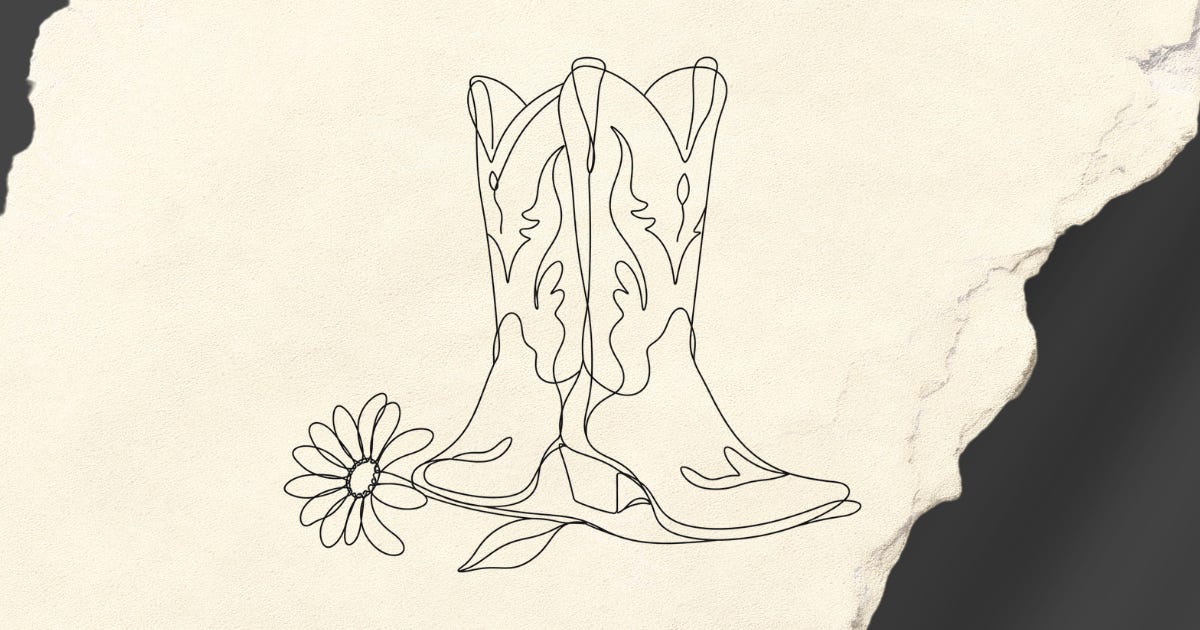
Right before I got married, my mom and I went shopping. He and I had decided we wanted a rustic wedding, and I really wanted to wear cowboy boots under my dress. So my mom offered to buy me a pair. Her treat.
And he said to me, “Well, what about me? Why don’t I get new boots?”
I swear, I don’t know how I didn’t clock this man's audacity sooner.
When my mom and I got in the car, she asked out loud why she would buy his boots. I could already feel where the night was going. She bought mine anyway, and we had a great day out together.
After she left, he was upset. She’d gotten me something, and he hadn’t gotten anything. So I told him I’d buy him new boots. We went out, he picked the pair he wanted, and I paid for them. We weren’t married yet. No joint account. It came out of my money.
By then I’d stopped expecting to keep anything good for myself. Something nice would show up, and I’d already be bracing for what it would cost me later.
So my mom bought me boots so I wouldn’t have to spend my own money. And I spent my own money anyway. On his.
There’s a name for what that costs you.
Let’s put our lab coats on for just a minute and talk about allostatic load. That’s the fancy science word for it. I guess that’s what happens when you cope by reading scientific research papers at two in the morning. It’s the wear and tear on the body when the stress never fully switches off. Your system is built to brace and then stand down. Mine just never got to the second part.
In 1993, McEwen and Stellar wrote a paper called “Stress and the Individual.” What they found was a reframe for stress. Before that, people thought of stress as one bad event. But what they figured out is that the system in your body that’s supposed to switch off sometimes stays on, when the stress keeps coming and you never get relief from it.
That’s what explains why the same stress wrecks one person and not another. It’s cumulative, and it’s individual. It’s based on your own history, and your own load.
Think back to that small piece of paper. Two people can go through the exact same event. For one, it’s the last shave, the one that finally makes them look down and see how much smaller their paper has gotten. For the other, it’s the first mark on the page, barely a line.
Ultimately, it’s your life and your experiences. You can call it what you want.
But until we start calling it what it is, it keeps getting minimized. By you, and by the people around you. And the more it gets minimized, the more it hurts. Not just you. Because you never know what someone else is carrying when they hear you wave yours away.