

A reader emailed me earlier in the week with a question I couldn’t stop thinking about. So, I decided to write this article for him and so many others. I’ll call him Andrew. That isn’t his real name, but he’s approved me sharing some of his story and his responses. He’s a veteran with a CPTSD diagnosis, and he wanted to know why so much of what I write seems to be for women.
Fair question. The obvious answer is that I’m a woman, and what I went through was very specific to being a woman. But if I’m honest, I never looked deeper than that. I just knew I could relate better to what women went through. Shame on me.
So much of this work is aimed at women, because women are seen as the ones who deal with emotional and relational trauma. And no, that’s not the truth, but it does seem to be the industry's perception. And it’s wrong. Men deal with it too, and perhaps get hurt twice. Once by the trauma, and again because they can’t voice it without being ridiculed. The whole alpha male thing doesn’t help. What is it called? The Manosphere? I watched a mind-blowing documentary on it on Netflix. Only watch it with nothing you can throw at your TV. I digress…
The numbers back it up. For regular PTSD, women are about twice as likely to develop it, roughly 8% of women and 4% of men over a lifetime. But for complex PTSD, a 2021 study across four countries found no consistent difference between men and women. In the UK sample, it was dead even. Men just aren’t getting in the door. In a 2025 UK survey, 29% of men had ever been to therapy, compared with 41% of women, and twice as many men said therapy was self-indulgent unless the problem was serious. But for those who went, an equal number of men and women found it helpful.
And even when they do get in the door, the people helping them may not know what they’re looking at. CPTSD has been in the World Health Organization’s diagnostic manual since 2022, but it still isn’t in the DSM, the manual most US providers use. Andrew spent years being treated for things he didn’t have.
It’s getting better. I’m seeing more creators and articles about men getting help and actually asking for it. But most of it is still about the big-T traumas, not the complex ones.
Andrew opened my eyes. I knew men suffered with this. What I hadn’t looked at was how much of what I teach applies to anyone. The strategy is the same. How someone gets to it can look different, and I’ll be generalizing here. Not every man or every woman fits these patterns, and this isn’t about one side being wrong or gendering any specific thing.
So I asked him what it’s actually like. He wrote back pages. Almost all of it could’ve come out of my book, which tells me the mask is the same mask. It just comes in a different costume.
The fire blanket
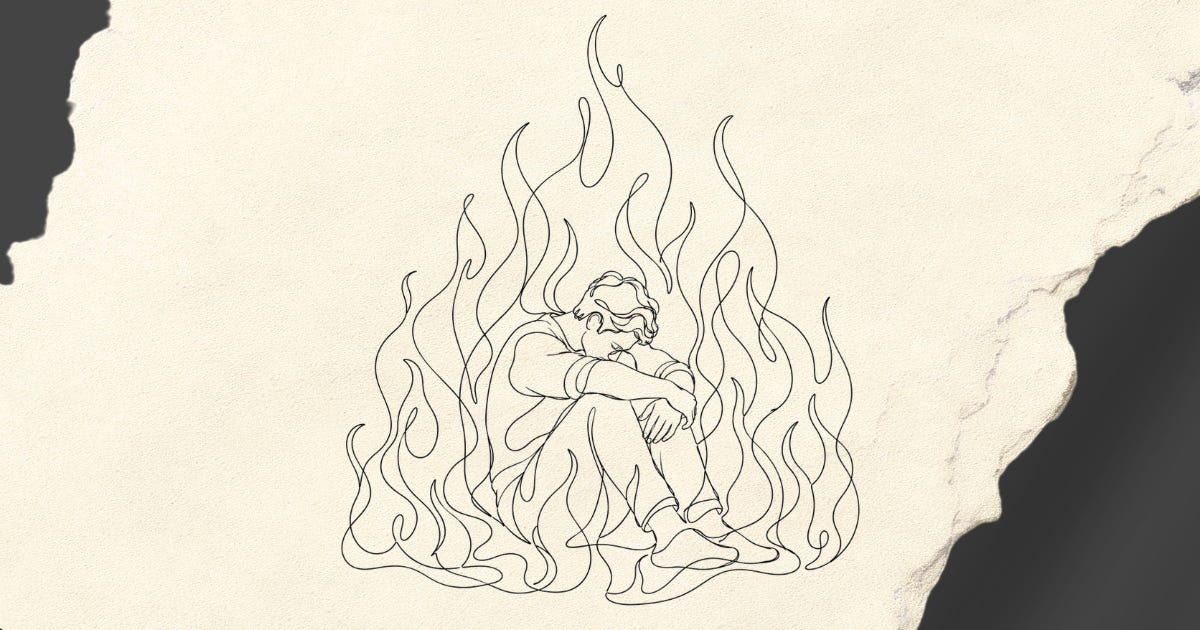
“Women... expect men to be a fire blanket in their life. You wrap around whatever issue and bring calm and safety to a situation. This is as much true at work as it is at home.”
Andrew raised an important point here. The women who love men carrying this. A lot of times the women are dealing with their own stuff, and they’re counting on the man to be the strong one, their co-regulator. So when he shows a crack, or can’t be that person for a while, she can feel hurt or slighted. Nobody’s the villain there. Two people are running low, and only one is allowed to say so.
When men go flat, they get praised for it. Calm, steady, unbothered. That’s what men are told they’re supposed to be. So the Ashes look like strength from the outside, and nobody checks on the fire blanket.
Put the lab coat on for a second with me, because a surprising amount of research has looked at this. Psychologist Ronald Levant named it normative male alexithymia. Alexithymia means having trouble putting feelings into words. Levant points to research showing that boys actually start life more emotionally expressive than girls. By about age 2, they’re less verbally expressive, and by about 4, less expressive in their faces. Somewhere in those first few years, the message about which feelings are allowed sinks in. His summary is the best line I’ve read on this: “Do I think it’s normative? Yes. Do I think it’s normal? No.”
Not every researcher loves the name. Some argue men can feel and name their emotions just fine, and they’ve been trained to keep them quiet. Either way, it looks the same from across the table: a man who’s gone flat, and a room full of people calling it strength.
What the Ashes look like from the other side of the table
“My brain wouldn’t recall the basic facts of what she just told me.”
She read it as not caring. Later, someone else heard what he was dealing with and called him broken.
I asked him what he wished people in his life understood better.
“When I mentally check out, it’s not about them, it’s not about the relationship, it’s my brain protecting me. My plate is overflowing and I am not able to take anything else in.”
“I don’t need advice... I need to know that you are there and that you care.”
Knowing isn’t the same as moving
This is for anyone, man or woman, who has done all the reading. You know the words: hypervigilance, negative self-image, overflowing plate. I was it throughout Andrew’s emails. You’ve done the therapy and read the books. And you still end up back in the same place.
You can understand the fire and still keep putting it out. You see the ember, things start burning away, and then it gets scary, so you go back to what was safe. And then the cycle starts again.
But some things can’t burn away. Family is the big one. The internet will tell you to cut off anyone who isn’t serving you. I’m not getting into the whole cutting people out of your life here. That is a way bigger discussion. But a lot of the time, these are people who love you. They think they’re helping. They just don’t know what you need, and no one can provide something they don’t understand.
That’s not hate. It’s misinformation.
Along the way, I had many times when I needed to let my flame burn an arrangement or relationship; I usually needed to burn away the person too. But the ones I kept were the ones who’d been trying to do good all along. I read them as bad because I couldn’t feel it. Their love sounded like criticism, like I’d never live up to their standards. But once the other stuff burned away, I realized they loved me and wanted me to see, and I just wasn’t able to yet.
Sometimes what has to burn isn’t the relationship. It’s the lens.
So how do you ask?
This is where Andrew is way ahead of most of us. While he’s doing well, he tells the people close to him what to watch for:
“If you see me doing x, y, and z, it’s most likely that I am experiencing this crash and it would help me if you ask me if I am okay.”
He isn’t asking them to fix him. He asks them to notice, and he tells them what he’ll be doing in the meantime.
And if they get it wrong? Asking is the micro moment. It’s something you wouldn’t have done before, and the courage it took is help in itself. Their no or lack of action is information about them. It isn’t a verdict on you. When I first started my business, I asked people for help, and some said no, without even asking what I needed. It hurt, and it felt personal. But I learned more from asking than I did from their no. The no didn’t change me, and it didn’t change the fact that I asked.
If asking anyone anything feels impossible right now, start smaller. At the grocery store, ask someone to grab that thing off the top shelf. Your brain will still write a story about them judging you, but you’ll never see them again. Then work your way up to the people you know.
Thank you Andrew for being so willing to share. I will be broadening my scope to be more inclusive in my writing.