



You’re in the grocery store, or the school pickup line, or the bathroom at work, and the feeling drops in like it has its own key to the apartment. The flat. The grey. The familiar internal weather you spent years fighting your way out of. And your first thought, before you can stop it, is:
Dammit. I’m here again. I haven’t actually gotten better. None of it took. I am right back where I started.
Hear me when I say this. You are not the only one. This is one of the most common, most painful, most universally devastating moments in the entire process of having a nervous system. And honestly, it’s because every framework you have ever been handed told you the goal was to leave the hard places in the past. So when you find yourself in one of them again, you read the return as failure.
But I am here to tell you, the return is the whole point.
Every traditional model of working through hard things is built on the same assumption: do the work, arrive somewhere stable, stay there. Heal as a finish line. Recover as a destination. Whatever the program is, the implied promise is that one day you will be transformed. The work will be behind you. The hard place will be a thing you used to go to, never to be seen or addressed again.
I bought this for years. I genuinely believed what I was doing in my late twenties and early thirties would lead to a version of me who didn’t have hard days anymore. I found someone I looked up to and aspired to be like. If I could only replicate her, but in my own body, I would be all set. I would do a round of therapy, feel better, lose some weight, get a promotion, and decide yes, this is it, I have arrived at the enlightened version of myself.
Then life would knock me sideways for seemingly no reason at all. And that new persona I was trying so hard to wear would disintegrate under the pressure. I would find myself back in the Ashes, looking around in horror at how familiar everything looked, and the only conclusion my brain could reach was I have failed at being better. I have undone all the work. I am back where I started and now I have to start over.
Spoiler. I had not failed. I had not undone the work. I was not back where I started.
I was in the Spiral, I didn’t know what the Spiral was yet.
When I finally started to draw it out on paper it became obvious that the terrain repeats.
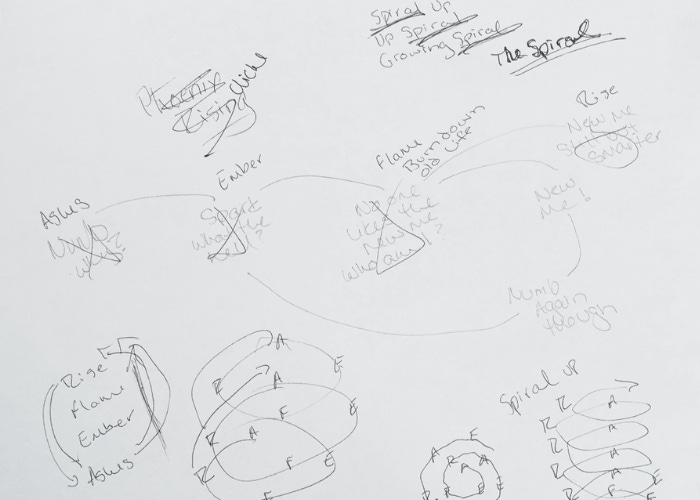
That part is real. You will be in the Ashes again. You will have Embers again. You will burn in the Flame again. You will reach Rise again, lose it, and come back to it. This is the design.
Not a circle. A spiral. Cycling through the same four states again and again, but never in exactly the same place twice. Each time you make it through a cycle, you’re at a different altitude with different access and vision.
What changes is where you are when you visit.
The first time I was in the Ashes, I had no idea what was happening. I thought my flatness was a personality. I thought I was just a low-energy person who needed to get her act together. I tried to push through with sheer willpower, which is exactly what makes the Ashes deeper. I had no map. No language. No way to even understand what I was experiencing was a state rather than as just who I was.
The second time I was in the Ashes, after the marriage ended, I had a little more language. I knew, vaguely, that what I was going through was a response to something. I still fought it. I still shamed myself for being there. But I had a flicker of this is happening to me, not this is me.
The third time I was in the Ashes, I knew exactly where I was. I recognized the flat. I recognized the conservation. I recognized the quiet drawer my body had filed everything into. And instead of fighting it, I said okay. I’m here. This is what my system needs right now. It will pass.
And it did pass. Faster than before.
That is the difference altitude makes.
The returns aren’t the problem. They are the pathway.
So let me save you years of irritation.
The first time you’re in the Ashes, you have no idea where you are. You think you’ve become a flatter person.
The second time you’re in the Ashes, you might still resist it, but somewhere in you there’s a small wait, I’ve been here before.
The third time, the recognition arrives faster. Oh. This. The flat. The conservation. I know this place.
The fourth time, you might catch it within days. I’m in the Ashes. My system is conserving. This will pass.
The terrain is more and more familiar every time.
That’s the mastery. Getting better at recognizing the state you’re in, fast enough that you stop piling on shame to exhaustion.
The return is the whole point. It’s not about what you do between the returns. It’s about what you do during them, every time, no matter what put you there.
Ok, so the next time you find yourself back in the Ashes, here is what I want you to do.
I want you to notice that you have been here before.
I want you to notice that the noticing is itself proof that you are at a different altitude than the last time. The previous version of you didn’t have the words. This version does.
So then stop, just for a second, and refuse to add shame to what is already a difficult experience. Your system does not need judgment on top of exhaustion. The judgment is the layer that turns a passable hard week into a months-long collapse.
Say to yourself, or out loud if you feel like it, my dog Willow has heard this way more than once, I am in the Ashes. This is familiar. I have been here before. I will be here again. This is not a failure. This is my system processing something. It will pass.
And then do whatever the phase requires. Rest if it’s Ashes. Stay with the flash if it’s an Ember. Refuse the performance if it’s the Flame. Take the next plain step if it’s Rise.
That’s it. Not transcendence. Not breakthrough. Not arrival. Just the ongoing recognition of where you are in the cycle, and the willingness to be there without making it worse.
I am not going to tell you the returns get easy. They don’t necessarily. The grief in the second Ashes is still grief. The flat in the third Ember is still flat. The clarity of the next Flame still costs you something. The terrain is real. The pain in it is real.
What changes is what you do with the pain. What changes is that you stop trying to graduate from your own nervous system and start working with it instead of against it.