

Haven’t located yourself yet? → Take You Are Here. Twelve questions, ninety seconds.
I was sitting on my bedroom floor, cross-legged, wondering if my fingers were supposed to touch.
I closed my eyes and immediately saw everything I wasn’t doing. Laundry still in the washer. Dishes in the sink. Emails unanswered. The sound of a tablet hitting something in the other room. She said my thoughts would float away like birds. I wondered if my jaw was clenched too hard, and how long ten minutes actually is, and then I noticed the dog hair all over my leggings and felt completely ridiculous — sitting there trying to regulate while covered in evidence that I hadn’t vacuumed in days.
I’d handed my kids their tablets and closed the door, which already felt like an act of selfishness. Spine tall. Hands resting somewhere intentional. I adjusted my legs, then my back, then my shoulders, and couldn’t work out whether I was supposed to be comfortable or disciplined. It occurred to me that there might have meant to be a candle.
Then the voice on the app came on, calm and confident, like it had never once tried to quiet a mind like mine. Close your eyes. Bring your attention to your breath.
She told me to notice my thoughts without judgment, and I felt a wave of panic, because my thoughts were nothing but judgment. About myself. About how bad I was at this. About how everyone else could presumably manage it.
By the end I felt worse than when I started. Not calmer. Not clearer. Just more aware of how loud my mind was and how incapable I seemed of quieting it.
I wasn’t only overwhelmed anymore. I was overwhelmed and failing at the thing that was supposed to help.
I was on that floor because my boss had prescribed me a business coach to improve my “executive functioning and communication strategies,” and she’d spent the first ten minutes of our call talking about my energy. My vibration. Opening myself to the frequency of success.
She was lit up about it. Genuinely convinced she was handing me the key to everything.
And I sat there thinking: I can barely get out of bed. I can barely feel my own face. What key? What lock?
But I smiled, because smiling was a reflex by then, and told her it sounded great and I’d give it a try.
It took me an embarrassingly long time to understand that the problem wasn’t my effort.
Most wellness tools assume you’re starting from a regulated baseline. Meditation requires a felt sense of safety in the body. Gratitude practice requires access to positive emotion. Breathwork requires being able to slow down without the slowing itself registering as a threat.
These are not bad tools. Some of them are excellent. They’re just built for a system that isn’t currently in survival mode.
Being told to meditate when you’re in the Ashes is like being asked to do yoga while treading water in the middle of the ocean. The instructions aren’t wrong. The location is.
You weren’t bad at the tool. You were handed the wrong tool for the terrain you were standing in.
That’s what this guide fixes.
What the Spiral is
The Spiral is a map of four states your nervous system moves through. I call them Ashes, Ember, Flame, and Rise.
You’ve been in all four. You’ll be in all four again. They aren’t levels, they aren’t stages, and they aren’t a personality type. They’re terrain — places you pass through, each with its own weather and its own requirements.
Why a spiral and not a line
Almost every recovery model you’ve been handed is a line. Stages of grief. Steps to healing. A before and an after, with you somewhere along it, hopefully further than last year.
Lines have a problem: they only allow one interpretation of going backward. If the model is a line and you end up somewhere you’ve already been, then something has gone wrong. You relapsed. You regressed. You lost the progress. You failed.
That is not what happens, and I argue that it has done more damage than most of the things people are actually recovering from.
Circles aren’t right either, though they’re closer. A circle says you come back around — true — but it also says you arrive at exactly the same place, unchanged, doing this forever. That’s the version people are terrified of. I’m going to be like this for the rest of my life.
A spiral is a circle that moves.
You come back around to the same terrain. Ashes again. Ember again. That part is real. But you don’t come back to the same point — you come back further out, at a different altitude, carrying everything the last pass taught you.
Same weather, different position on the mountain.
Which means the two things people fear most about this are both half wrong. You don’t escape the cycle, and you were never going to. But you also don’t repeat it. You’re not doing laps. You’re climbing.
Why this matters more than it seems
Because it changes what a return means.
The single most common thing I hear is some version of: I thought I was past this. Somebody has two good years and then lands back in Ashes and concludes the two years were fake. That every bit of it has to be done over from scratch.
They haven’t gone back. They’re on a different pass through the same terrain, and they’re arriving with things they didn’t have last time — a name for it, an idea of how long it lasts, some sense of what makes it worse.
That’s not the same trip. It only looks the same from directly above.
But let’s be clear:
It isn’t a ladder. There’s no top. Rise is not the goal and Ashes is not the failure. They’re both just places, and you’ll stand in both more than once.
It isn’t a diagnosis. This is a self-locator, not a clinical instrument. It won’t tell you what you have. It’ll tell you where you are.
It isn’t a path back to a fixed version of you. Your nervous system is adaptive and intelligent, and it moves forward, not backward toward some earlier ideal state that, if we’re honest, never actually existed.
The three laws
Everything else in this guide sits on these.
1. You will return to each terrain.
You’re a human with a nervous system living in a world that keeps happening.
This is the law people fight hardest, and it’s the one that causes the most unnecessary suffering. Almost everyone I’ve worked with has interpreted a return to Ashes as evidence that the last two years were wasted. They weren’t. Returning is not regression — it’s the mechanism. It’s what the system does.
2. You return with more awareness.
Same terrain, different altitude. The fourth time you land in Ashes, you’re not the person who landed there the first time. You know what it is. You know it’s temporary. You know what it needs, and — more importantly — you know what makes it worse.
That’s not nothing. That’s most of it, actually.
3. Rising gets faster.
This is the only promise in the entire framework, and it’s the one I’d stake everything on.
Nobody stops spiraling. The goal is to shorten the trip through — what used to take six months takes six weeks, then a week.
I can’t stop the fall. I can shorten the climb. That’s the whole offer.
The four terrains
Haven’t located yourself yet? → Take You Are Here. Twelve questions, ninety seconds.
🌑 Ashes
What it is: conservation. Not failure — conservation. When the load has been too heavy for too long, your system does the sensible thing and starts shutting off everything that isn’t strictly required. Emotion is expensive. Curiosity is expensive. Wanting things is extremely expensive. So they go offline first.
From the inside: flat. Not sad, not devastated — flat. You do the day and don’t remember most of it. You clean the whole kitchen and come to on the back porch with no memory of walking out there. Somebody asks how you are and “fine” is out of your mouth before you’ve had a thought about it.
From the outside: completely functional. This is why nobody asks. You’re still getting everything done, and getting things done is the only signal most people know how to read.
What it gets mistaken for: laziness. Depression, sometimes correctly and often not. Being “over it.” Coping well. Being remarkably calm about something you should probably be more upset about.
What Ashes needs: subtraction. Fewer things, not better systems. This is the one terrain where doing less is the actual work, and where every instinct you have — push through, get organized, make a plan, fix it — makes it last longer.
One thing to do: take one real thing off the list this week. Not the smallest one. One that matters.
One thing to stop: trying to feel something. You’re not blocked. You’re conserving, and it will come back on its own schedule.
A note, because it matters: if this is heavier than a map can hold. If you’re not sleeping, not eating, or having thoughts that frighten you, please talk to a doctor or a therapist. A framework is a useful thing but it is not care. If you are in active crisis, you can find helpful resources HERE.
🔥 Ember
What it is: something coming back online. Noticing returns first, usually before capacity does, which is why this terrain is so uncomfortable. You can now feel things you couldn’t feel a month ago, and you don’t yet have the room to do anything about them.
From the inside: tender and irritable at the same time. You’ve started noticing the jaw, the shoulders, the way you hold your breath. You’ve started saying out loud that something isn’t right. You want things again, faintly, and wanting is exhausting.
From the outside: often worse than Ashes. People frequently get more visibly upset in Ember than they ever were in Ashes, which confuses everyone, including them.
What it gets mistaken for: getting worse. Backsliding. A breakthrough. It’s none of those — it’s the lights coming back on in a house you haven’t looked at in a while.
What Ember needs: permission to notice without acting on it. This is the hardest ask in the whole framework, because noticing feels like it demands a response.
One thing to do: name one thing out loud to one person. That’s it. Don’t fix it.
One thing to stop: turning it into a project. The most common way people lose Ember is by reading nine books, researching the diagnosis, and building a plan. That’s not progress. It’s a very convincing way to stay busy instead of staying with it.
🔆 Flame
What it is: mobilization. Energy is back and it’s moving. This is the terrain the world rewards — you’re productive, decisive, getting things done, and people are impressed.
From the inside: momentum, and often a slight edge underneath it. You’re doing rather than feeling, and doing is easier. Sleeping badly, running fine. Nine plans for the next six months.
From the outside: thriving. Back to yourself. Finally doing well.
What it gets mistaken for: recovery. And sometimes it is. But Flame and panic run on identical fuel and look identical from the outside, and the difference isn’t whether you’re moving — it’s whether you could stop if you wanted to.
What Flame needs: containment and direction. Not more energy. A channel for the energy you’ve got, and an honest look at whether the pace is a choice or a requirement.
One thing to do: pick one thing to finish, and let two things go unfinished on purpose. Notice what that feels like. The feeling is the information.
One thing to stop: starting things. Flame’s appetite is bigger than its capacity, and unchecked Flame goes to Ashes — which is the single most common route into Ashes there is.
🌤️ Rise
What it is: footing. You can hold more than one thing at a time — the hard part and the ordinary part, in the same day, without one erasing the other. You’re making choices instead of reactions.
From the inside: ordinary, mostly. This is the thing nobody warns you about. Rise doesn’t feel like triumph. It feels like a normal Tuesday where nothing is on fire and you’re actually there for it.
From the outside: roughly the same as Flame, which is why people chase Flame thinking they want Rise.
What it gets mistaken for: the destination. It isn’t. Rise is a terrain, not a finish line. You will leave it, and that isn’t relapse — it’s how the system works. Anybody selling you a permanent version of this is selling you something.
What Rise needs: reps and evidence. This is where capacity actually gets built, which makes it the terrain to use rather than the one to protect. What you build here is what shortens the next Ashes.
One thing to do: one thing that’s slightly more than comfortable. Building requires load.
One thing to stop: treating it as fragile. Tiptoeing around a good stretch so you don’t disturb it is how you waste the only terrain where growth is actually available.
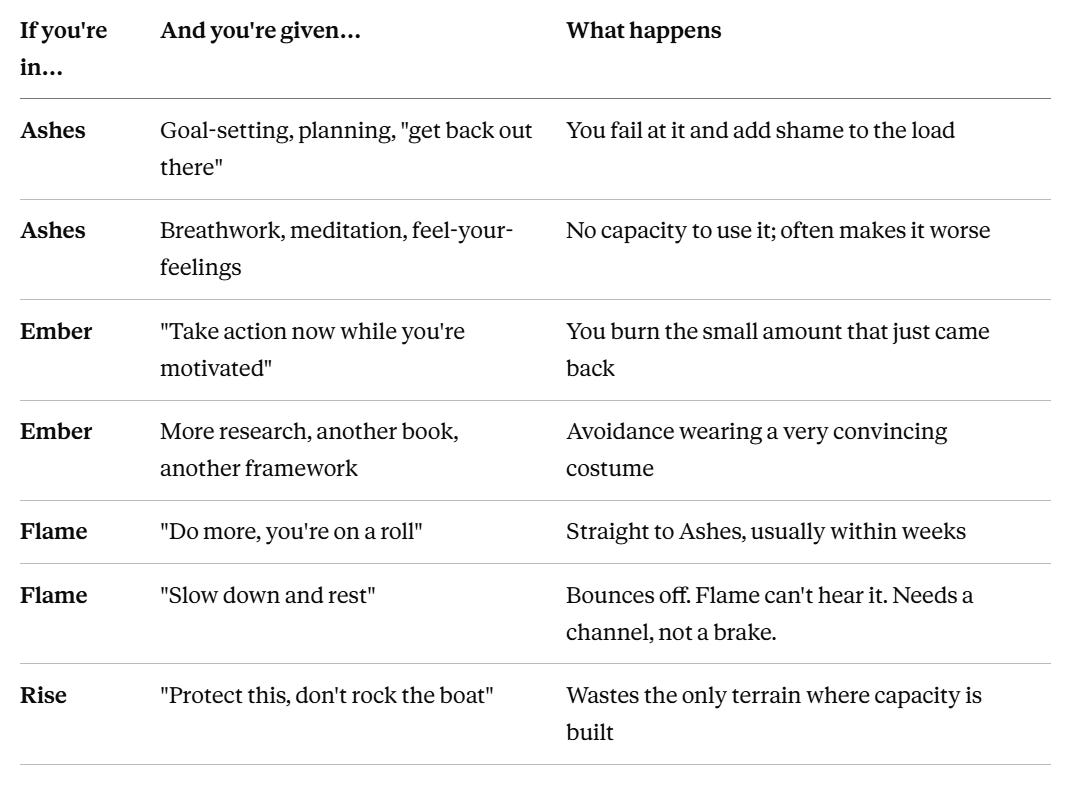
How to use this
Locate before you act. Before you decide what to do about how you’re doing, work out where you are. The answer changes the instruction completely.
Check weekly, not daily. These terrains move on the order of weeks and months, not hours. A bad Tuesday isn’t a terrain change.
Watch the recovery time, not the state. The number that matters isn’t which terrain you’re in. It’s how long the last hard stretch took to move through, compared to the one before it. That’s the only real measurement of progress in this system, and it’s the one that gets better.
Expect to be wrong about Flame. Most people misread it, in both directions. Ask the stopping question: could I stop if I wanted to?
What’s next
This guide is the map. It’ll tell you where you are and give you a direction.
What it doesn’t do is get into the weeds of any one terrain — the full protocol, the specific traps, what to do when it doesn’t shift, how to tell the difference between real movement and a good week. That’s what the four terrain guides are for, one per state, and they go to paid members of The Cost of Functioning.
And if you’d rather work it through with people than read about it, that’s what the live room is. Each quarter I run a season — six weeks, one terrain at a time, with whatever the people in the room actually bring.
Haven’t located yourself yet? → Take You Are Here. Twelve questions, ninety seconds.